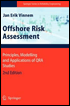
Offshore Risk Assessment: Principles, Modelling and Applications of QRA Studies, 2nd Edition
There is a long tradition in the Norwegian offshore industry of the use of risk acceptance criteria. At present however, there is an ongoing debate about whether one should continue to use risk acceptance criteria or not. The author actually favours an alternative approach, whereby generation of alternatives and ALARP assessments replace the more mechanistic use of risk acceptance criteria. This is discussed at length in Aven and Vinnem (2007).
But history cannot be ignored; risk acceptance criteria have been used and continue to be used. This chapter is primarily devoted to a discussion of the background to how the risk acceptance criteria were established. This comes to a large extent from the current risk levels. It is therefore appropriate as a starting point, to discuss the current risk levels, exemplified by values from the North Sea.
An extensive study of the risk levels on the Norwegian Continental Shelf (NCS) has been carried out (Vinnem and Vinnem, 1998). This study was concerned mainly with accidents in the Norwegian sector of the North Sea, and covered risk to personnel, environment, and assets. The following is a summary of the results for the risk to personnel, limited to fatality risk, updated with the latest available data.
There have been 81 fatal accidents and 266 fatalities in Norwegian offshore operations since the start of oil and gas operations in 1966. This excludes fatalities on shuttle tankers (which are used for transport to...