Offshore Risk Assessment: Principles, Modelling and Applications of QRA Studies, 2nd Edition
This chapter defines risk quantitatively and presents the dimensions and elements of risk. The chapter further gives an extensive illustration of how risk is expressed. Further discussion about interpretation of risk may be found in Aven and Vinnem (2007) and Aven (2003).
The term 'risk' is according to international standards (such as ISO 2002) 'combination of the probability or an event and its consequence'. Other standards, like ISO 13702 (ISO 1999b), have a similar definition: 'A term which combines the chance that a specified hazardous event will occur and the severity of the consequences of the event.'
Risk may be expressed in several ways, by distributions, expected values, single probabilities of specific consequences, etc. Most commonly used is probably the expected value.
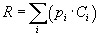
An operational expression for practical calculation of risk is the following, which underlines how risk is calculated, by multiplying probability and numerical value of the consequence for each accident sequence i, and summed over all ( I) potential accident sequences:
| (2.1) | |
where:
p = probability of accidents
C = consequence of accidents
This formula expresses risk as an expected consequence. The expression may also be replaced by an integral, if the consequences can be expressed by means of a continuous variable.
It should be noted that the expression of risk as expected consequence is a statistical expression, which often implies that the value in practice may never be observed. When dealing with rare accidents, an...