Packet Broadband Network Handbook
Providing all of the relevant details on enabling technologies, this easy-to-navigate resource will give you all the context you need to put them in perspective and make well-informed choices.
 TABLE OF CONTENTS
 Part II of this book focuses on the digital broadband transport networks that provide physical layer services, namely, transmission of bits and bytes of information, without regard to the upper-layer network protocol. Part II reflects the evolution of the digital transport technologies as shown in Fig. P2-1 and as discussed in the following three chapters: Digital Transmission Systems and SONET (Chap. 5), WDM Networks (Chap. 6), and Optical Ethernet (Chap. 7).
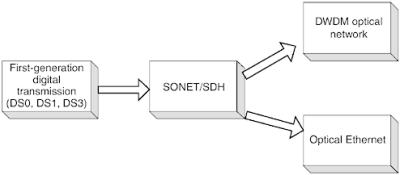
The first-generation digital transmission system, represented by the Digital Signal (DSx) system and T-carrier (e.g., T1, T3, etc.) in North America, used copper wire as the transmission medium and achieved a data rate of over 50 Mbps. The next generation uses optical fiber as the transmission medium, and are represented by the Synchronous Optic Network (SONET) standard in North America and the Synchronous Digital Hierarchy (SDH) standard in Europe; both standards are still widely deployed. The third-generation optical transport network is characterized by signal switching at the optical level and a dense wavelength division multiplexing (DWDM) that combines many wavelengths onto a single optical fiber.
Optical Ethernet combines the ubiquitous Ethernet technology and wave division multiplexing (WDM) network technologies to provide an alternative optical transport network technology that extends the reach of Ethernet into metro and wide-area networks.
Digital transmission systems as described in this section refer to the...