Packet Broadband Network Handbook
Providing all of the relevant details on enabling technologies, this easy-to-navigate resource will give you all the context you need to put them in perspective and make well-informed choices.
 TABLE OF CONTENTS
 Part III, the core of this book, is a comprehensive review of current packet broadband access network technologies. A broadband access network provides a broadband connection between a core network and residential or enterprise end users. Traditionally the access network connection has been a 64/56-Kbps telephone line for residential and T1 (1.55 Mbps) for enterprise customers. Access network technologies remained stagnant for decades until the Internet-driven data services created a huge market for packet broadband access networks.
For convenience of description, broadband access network technologies are divided into two categories: last mile solutions and last yard solutions. Last mile solutions provide broadband connections between a backbone network and customers premises. For example, a fiber network provides broadband access from a central office to the curbs of residential homes or to telecom boxes outside office buildings. Last yard solutions start where last mile solutions end: they provide broadband connection to user devices. For example, they connect the fiber terminating at a curb or building floor to a PC at a user s desk.
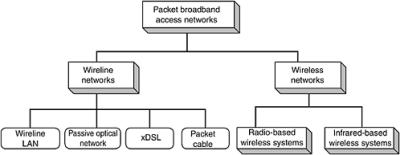
Another dimension of broadband access networks is the distinction between wireline and wireless technologies, as shown in Fig. P3-1.