3.2 Elements of Probability
We start with estimates on deviations of random variables. Let X be a random variable with expectation E( X) and second central moment var( X) = E(( X ? E( X)) 2). Let X take only nonnegative values.
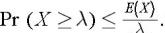
Theorem 3.27 (Markov s inequality) For any nonnegative random variable, X,
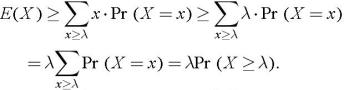
Proof This is a proof for discrete random variables; generalization to the continuous case is straightforward. Since X takes only nonnegative values,
Note that we can substitute any positive function f for X,
If, moreover, f is a nondecreasing function, we get
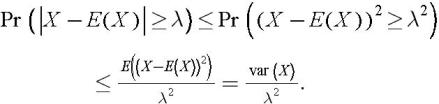
Theorem 3.28 (Chebyshev s inequality) For any random variable X,
Proof We choose f ( X) = X 2, and have
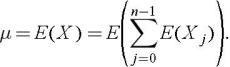
Let X now be a sum of n independent random variables X j, j = 0 , 1 , , n ? 1. We denote by ? the expectation of X, and have
Theorem 3.29 (Chernoff bound)
Proof We pick f( X) = e ?X, and compute
Now
and we are done.
In the above we essentially used the multiplicative property of the function e ?x, namely that
The exponential function of the purely imaginary argument,
also possesses this property.
Let X be a random variable having probability density function (p.d.f.), f ( x). The characteristic function ? of


 TABLE OF CONTENTS