Powder Metallurgy Technology

Giving particular emphasis to those processes which are of industrial significance, this useful text provides detailed coverage of metal powder production, compaction, sintering, hot consolidation, and much more.
 TABLE OF CONTENTS
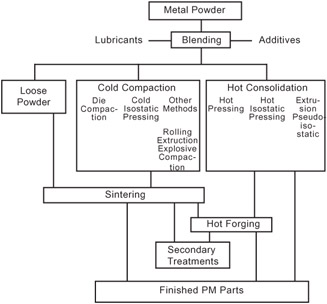
 The technology of pressing metal powders into a specific shape is not new; older civilizations practised the art in prehistoric times, as bear witness the iron pillar in Delhi, certain Egyptian implements and articles of precious metals made by the Incas. Modern powder metallurgy (P/M) technology commenced in the 1920s with the production of tungsten carbides and the mass production of porous bronze bushes for bearings. During the Second World War, further development took place in the manufacture of a great variety of ferrous and nonferrous materials, including many composites and a steady growth period developed during the postwar years until the early 1960s. Since then, growth of P/M has expanded more rapidly, mainly because of three potential reasons - economical processing, unique properties and captive processes. Primarily, the P/M process is a rapid, economical and high volume production method for making precision components from powders. However, there are a number of related consolidation techniques whereby powders can be rolled into sheet, extruded into bars, etc., or compacted isostatically into parts of more involved geometry. Over the last decade, the technology of powder forging has established itself for fabricating powders into precise engineering parts which have properties comparable with those of conventional forgings. Figure 1.1 shows the general flow sheet of powder metallurgy processing.
During the past decade, there have been significant advances in powder manufacturing techniques. New types of powders with superior properties allow the production of larger and higher...