Power Plant Water Chemistry: A Practical Guide

Deposition of contaminants and corrosion are common in boilers and are the cause of many forced outages. Material damage and lost power generation or product output due to corrosion cost electric utilities and industries billions of dollars per year. This chapter outlines the principal mechanisms of boiler chemistry upsets and discusses treatment methods to minimize them. Preceding this discussion is a brief look at some of the common boiler types used in the fossil-fired steam generating industry.
The most popular boilers at industrial facilities and electric utilities are of the drum variety. They are so called because of the presence of a steam drum, which gives the boiler some unique operating characteristics. Large industrial and utility drum boilers must be erected in the field, but smaller boilers are often shipped and installed as package units.
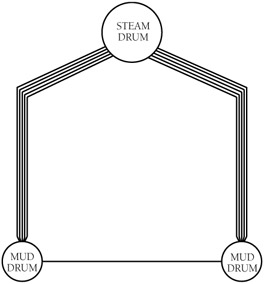
Many industrial plants generate steam only for process use or to drive small turbines. For these applications, preconstructed, package boilers are often sufficient. Figures 3-1 through 3-3 illustrate the simplified circuitry of three of the most common package boiler designs, the "A," "D," and "O" types. Natural gas or oil is the principal fuel for these boilers. Steaming rates typically range from 40,000 to 200,000 pounds per hour, with 100,000 pounds per hour being very common. As the figures indicate, each of the boilers contains one or more mud drums. The mud drum(s) serves as a collection site for precipitates formed by chemical treatment programs.
General...