Power Plant Water Chemistry: A Practical Guide

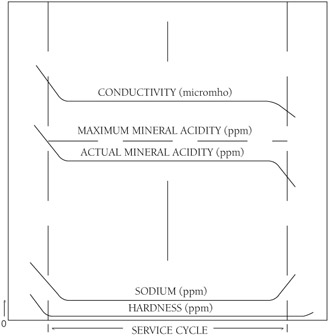
Figure 5-31 illustrates the typical effluent water quality from a cation bed during a normal service cycle. At the very beginning of the service cycle, the effluent is dumped to waste because it contains trace amounts of acid. The acid residual usually disappears quickly. The effluent water is routed into the system just as this process reaches completion. During the service cycle, the cation efflu-ent contains free mineral acids (FMA), e.g., H 2SO 4, HCl, and also H 2CO 3 and a small amount of sodium. Once the bed has reached exhaustion, sodium begins to break through. The FMA and conductivity both begin to decline because the excess sodium combines with anions to form neutral salts. Of these changes in effluent quality, the increase in sodium is most easily detected. On-line sodium monitoring can be very effective in detecting resin exhaustion.
Effluent Characteristics SAC Exchanger
The quality of water during an anion service cycle is outlined in Figure 5-32. A slight conductance is always present in the effluent because the sodium ions that leak from the cation exchanger form sodium hydroxide in the anion bed. The conductivity usually remains constant throughout the service run. Likewise, the effluent contains a constant level of silica due to leakage of this weakly held constituent. When the anion exchanger exhausts, silica levels almost immediately begin to rise. On-line silica monitoring can be a very effective tool to detect resin exhaustion. Another phenomenon also...