Practical Analog and Digital Filter Design

2.2: BUTTERWORTH NORMALIZED APPROXIMATION FUNCTIONS

2.2 BUTTERWORTH NORMALIZED APPROXIMATION FUNCTIONS

The Butterworth approximation function is often called the maximally flat response because no other approximation has a smoother transition through the passband to the stopband. The phase response also is very smooth, which is important when considering distortion. The lowpass Butterworth polynomial has an all-pole transfer function with no finite zeros present. It is the approximation method of choice when low phase distortion and moderate selectivity are required.

2.2.1 Butterworth Magnitude Response

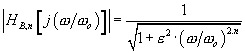
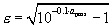
Equation 2.6 gives the Butterworth approximation's magnitude response where ? o is the passband edge frequency for the filter, n is the order of the approximation function, and ? is the passband gain adjustment factor. The transfer functions will carry subscripts to help identify them in this chapter. In this case, the subscript B indicates a Butterworth filter, and n indicates an nth-order transfer function.

(2.6)

where

(2.7)

If we set both ? = 1 and ? o = 1, the filter will have a gain of 1/2 or -3.01 dB at the normalized passband edge frequency of 1 rad/sec.

The Butterworth approximation has a number of interesting properties. First, the response will always have unity gain at ? = 0, no matter what value is given to 8. However, the gain at the normalized passband edge frequency of ? = 1 will depend on the value of ?. In addition, the response gain decreases by a factor of -20 n

UNLIMITED FREE
ACCESS
TO THE WORLD'S BEST IDEAS

SUBMIT
Already a GlobalSpec user? Log in.

This is embarrasing...

An error occurred while processing the form. Please try again in a few minutes.

Customize Your GlobalSpec Experience

Category: IC Electronic Filters
Finish!
Privacy Policy

This is embarrasing...

An error occurred while processing the form. Please try again in a few minutes.