Practical Analog and Digital Filter Design

The Chebyshev approximation function also has an all-pole transfer function like the Butterworth approximation. However, unlike the Butterworth case, the Chebyshev filter allows variation or ripple in the passband of the filter. This reduction in the restrictions placed on the characteristics of the passband enables the transition characteristics of the Chebyshev to be steeper than the Butterworth transition. Because of this more rapid transition, the Chebyshev filter is able to satisfy user specifications with lower-order filters than the Butterworth case. However, the phase response is not as linear as the Butterworth case, and therefore if low phase distortion is a priority, the Chebyshev approximation may not be the best choice.
The magnitude response function for the Chebyshev approximation is shown in (2.19):
| (2.19) | |
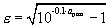
where the definition of ? is again
| (2.20) | |
and C n( ?) is the Chebyshev polynomial of the first kind of degree n. The normalized Chebyshev polynomial ( ? o = 1) is defined as
| (2.21a) | |
| (2.21b) | |
We can see that the mathematical description used for this approximation is more involved than the Butterworth case. We will be concerned with the expression where ? > 0, but the Chebyshev polynomial has many interesting features which are discussed in the references at the end of this text.
The order of the Chebyshev filter will be dependent on the specifications provided by the user. The general form of the calculation for...