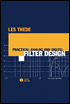
Practical Analog and Digital Filter Design
Everyone has probably come in contact with one type of filter or another in their lifetime. Maybe it was a coffee filter used to separate the grounds from the liquid, or perhaps an oil filter to remove contaminants from the oil of an engine. Anyone working in an office often filters the unimportant work from the important. In essence then the act of filtering is the act of separating desired items from undesired items. Of course when we discuss filters in this text, we are not talking about coffee, oil, or paperwork, but rather electronic signals. The electronic filters we will be designing will separate the desirable signal frequencies from the undesirable, or in other applications simply change the frequency content which then changes the signal waveform.
There are many types of electronic filters and many ways that they can be classified. A filter's frequency selectivity is probably the most common method of classification. A filter can have a lowpass, highpass, bandpass, or bandstop response, where each name indicates how a band of frequencies is affected. For example, a lowpass filter would pass low frequencies with little attenuation (reduction in amplitude), while high frequencies would be significantly reduced. A bandstop filter would severely attenuate a middle band of frequencies while passing frequencies above and below the attenuated frequencies. Filter selectivity will be the focus of the first section in this chapter.
Filters can also be described by the method used to approximate the ideal filter. Some approximation methods emphasize...