A Primer for Sampling Solids, Liquids, and Gases: Based on the Seven Sampling Errors of Pierre Gy

Appendix E: Experiments

Below are three experiments that you can perform easily, even at home. They illustrate some of the issues discussed in Chapter 3. The first addresses sampling dimension, the second solids sampling, and the third liquid sampling.

Experiment 1: Sampling Dimension

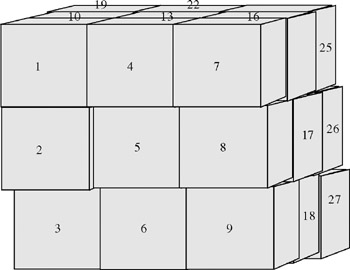
Get 27 building blocks or facsimile. Vary the colors or design of the blocks as much as possible. Put them in stacks of 3 and arrange the stacks to form a 3 3 3 cube, as in Figure E.1.


Figure E.1: 27 numbered blocks arranged in a cube.

The analogy is a three-dimensional pile of coal, catalyst, plastic pellets, soil particles, or other solid material. It could be in the field, plant, or lab. From each of these perspectives, consider how you would physically obtain several randomly chosen individual blocks from this group of 27. How would you access material in the middle, realizing that the material readily accessible on the top or outside may not be representative? How would you define a correct sample and extract it? Next, reduce the sampling dimension to 2 or 1. Define and extract correct samples. How well would this work in situations you encounter? Review your methods and logic after segregating the blocks by color from top to bottom or using some other pattern.

Experiment 2: Solids

Get two or three different types of dried beans. Lentils, black beans, and garbanzo beans work well because they have different sizes, shapes, and densities. Weigh the amount of each bean type. Compute and...

UNLIMITED FREE
ACCESS
TO THE WORLD'S BEST IDEAS

SUBMIT
Already a GlobalSpec user? Log in.

This is embarrasing...

An error occurred while processing the form. Please try again in a few minutes.

Customize Your GlobalSpec Experience

Category: Powder Thieves and Powder Samplers
Finish!
Privacy Policy

This is embarrasing...

An error occurred while processing the form. Please try again in a few minutes.