A Primer for Sampling Solids, Liquids, and Gases: Based on the Seven Sampling Errors of Pierre Gy

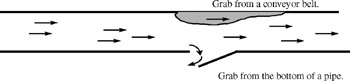
The most common error in defining the sample is grab sampling. Gy defines grab sampling as "the art of collecting increments from the most accessible part of the batch." The more heterogeneous the lot in its constitution or distribution (CH or DH), the less representative a grab sample will be. Examples of grab sampling include sampling from the top of a pile, the bottom of a drum using a spigot, the side of a conveyor belt, or the bottom of a pipe. The latter two are illustrated in Figure 3.1.
Grab sampling does not follow the principle of correct sampling since certain parts of the lot have no chance of being in the sample. Thus, our estimate of the amount of the constituent of interest may be biased, and we cannot calculate a statistical error for it. In other words, not only have we reduced our chances of getting a representative sample, but we also have no idea how bad it is! Autosamplers that penetrate only the edge of a flowing stream, as in Figure 3.1, are commonplace, but they are just glorified grab samplers.
The most common error in physically obtaining the sample occurs when the sampling tool cannot take the sample that has been properly defined. For example, an extraction error is produced by a retractable cross-stream sampler...