Processes for Engineering a System
The purpose of this Standard is to provide an integrated set of fundamental processes to aid a developer in the engineering or re-engineering of a system.
 TABLE OF CONTENTS
 The various commercial and non-commercial enterprises, within widely diverse domains, have similar enterprise-based life cycles, and generally exist for the same purpose. That purpose is to incrementally develop systems and control passage from one increment to another so as to reduce risk, control costs, and provide and maintain system products that will be competitive and provide user satisfaction throughout the life cycle.
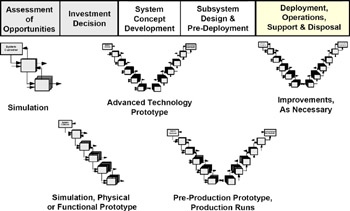
Each enterprise-based life cycle is characterized by distinct phases marked by established exit criteria and management reviews to ensure that the exit criteria are satisfied prior to making a decision on whether or not to approve progress to the next phase or sequence of phases, or to make modifications or improvements to maintain competitiveness. Although the various enterprise-based life cycles might have different named phases, and different phase and life cycle time periods, most, if not all, have these five distinct functional phases: (1) assessment of opportunities, (2) investment decision, (3) system concept development, (4) subsystem design and pre-deployment, and (5) deployment/installation, operations, support, and disposal.
Figure B.1 shows five typical phases of an enterprise-based life cycle and the use of appropriate engineering life cycle activities to meet the exit criteria for the enterprise-based life cycle phases.
| Note |
|