Processes for Engineering a System
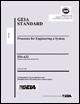
The purpose of this Standard is to provide an integrated set of fundamental processes to aid a developer in the engineering or re-engineering of a system.
 TABLE OF CONTENTS
 This Annex provides an informative list of typical documents and their contents taken from various commercial and non-commercial domains. Selection and use of these documents depends on agreement requirements and the nature and scope of the project.
During early phases of the enterprise-based life cycle, system concepts are often vague and unstructured. Typical concept source documents include:
Concept Specification. This includes a features list for a new or improved system or product. It identifies the scope of the features and their priority to provide an edge in the market.
Maintenance Concept. This focuses on life cycle logistics goals, objectives, constraints, and general support capabilities related to a desired system or product.
Operations Concept (or Concept of Operations). This focuses on the goals, objectives, and general desired capabilities of a potential system or product (new or improved), without indicating how the system or product can be implemented.
Disposal Concept. This focuses on the planned disposition of the end products, and by-products produced throughout the life cycle of the system.
Request for Proposal (RFP). This can include one or more of the above initiating documents. Its purpose is to solicit bids for consideration from several sources to develop a system or product.
For creation activities (system definition, subsystem design, detailed design and integration, and test and evaluation) of the engineering life cycle, source documents are much more definitive and include one or more of the following:
Contract. This type of negotiated document is...