8-9 MULTICOMPONENT VAPOR-LIQUID EQUILIBRIA AT LOW PRESSURE
The equations required to calculate vapor-liquid equilibria in multicomponent systems are, in principle, the same as those required for binary systems. In a system containing N components, we must solve N equations simultaneously: Eq. (8-4.1) for each of the N components. We require the saturation (vapor) pressure of each component, as a pure liquid, at the temperature of interest. If all pure-component vapor pressures are low, the total pressure also is low. In that event, the factor  [Eq. (8-4.2)] can often be set equal to unity.
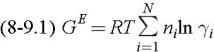
Activity coefficients ? i are found from an expression for the excess Gibbs energy, as discussed in Sec. (8-5). For a mixture of N components, the total excess Gibbs energy G E is defined by
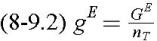
where n i is the number of moles of component i. The molar excess Gibbs energy g E is simply related to G E by
where n T, the total number of moles, is equal to  .
.
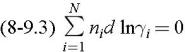
Individual activity coefficients can be obtained from G E E upon introducing the Gibbs-Duhem equation for a multicomponent system at constant temperature and pressure. That equation is
The activity coefficient ? i is found by a generalization of Eq. (8-5.3):
where n j=i indicates that all mole numbers (except n i) are held constant in the differentiation.
The key problem in calculating multicomponent vapor-liquid equilibria is to find...

 TABLE OF CONTENTS