The Properties of Gases and Liquids, Fifth Edition
Thermal conductivities of both gases and liquids are considered in this chapter. Some background relevant to the theory of thermal conductivity is given in Secs. 10-2 and 10-3 (for gases) and in Sec. 10-8 (for liquids). Estimation techniques for pure gases at near ambient pressures are covered in Sec. 10-4; the effects of temperature and pressure are discussed in Secs. 10-4 and 10-5. Similar topics for liquids are covered in Secs. 10-9 to 10-11. Thermal conductivities for gas and for liquid mixtures are discussed in Secs. 10-6, 10-7, and 10-12. Thermal conductivities of reacting gas mixtures are not covered but are reviewed in Curtiss, et al. (1982).
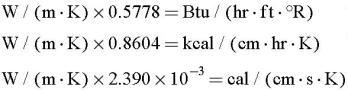
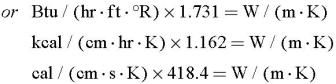
The units used for thermal conductivity are W/(m K). To convert these to English or cgs units:
or
In Sec. 9-3, through rather elementary arguments, the thermal conductivity of an ideal gas was found to be equal to v LC v n/3 [Eq. (9-3.7)], where v is the average molecular velocity, L is the mean free path, C v is the constant volume heat capacity per molecule, and n is the number density of molecules. Similar relations were derived for the viscosity and diffusion coefficients of gases. In the case of the last two properties, this elementary approach yields approximate but reasonable values. For thermal conductivity, it is quite inaccurate. A more detailed treatment is necessary to account for the effect of having a wide spectrum of molecular velocities; also,...