Radio-Electronic Transmission Fundamentals, Second Edition
Although the class B linear amplifier provides a simple and effective means for amplifying a modulated carrier, its low carrier efficiency is a definite disadvantage, particularly where high power is required. It became apparent long ago that a much more efficient system of linear amplification was needed, so that high power could be obtained in this manner without requiring such enormous plate-dissipation capability in the amplifier tubes. Plate modulation, on the other hand, requiring additional expensive transformers and tubes and involving the handling of extremely high peak plate voltage, does not usually provide the most practical approach to the production of a really high-power modulated signal.
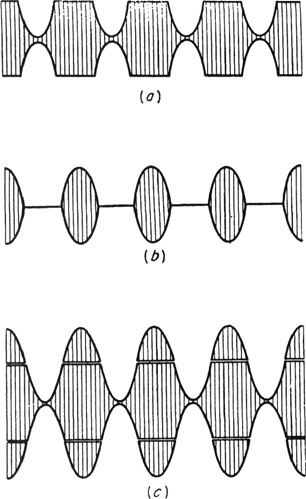
We can greatly increase the efficiency of a class B amplifier by increasing the grid excitation until the tube is saturated. If the excitation is then modulated, the output waveform of the amplifier will appear as in Fig. 63-1 a. The output voltage cannot rise above carrier level, because the tube is already saturated at carrier level; but it does follow the modulation waveform accurately from carrier level down to zero, because of the linear characteristics of the class B amplifier.
Now let us consider the result if we adjust the bias of another amplifier to class C conditions and apply only enough grid excitation to make the tube just barely begin to conduct plate current. If we then modulate this excitation, the tube will be driven to substantial plate current only during...