RF Systems, Components, and Circuits Handbook, Second Edition

Some of the information presented in this section is adapted from [1].
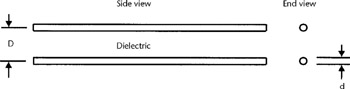
Many types of transmission lines can be used for RF applications. One type that is frequently used is the two-wire line. Figure 11.1 shows a two-wire transmission line.
Unshielded two-wire lines are often used when line pickup or radiation from the line is not too important. They have the capability for high-power handling and usually are constructed to provide either 300 ? or 600 ? characteristic impedance. The common two-wire television cable used for connecting a television antenna and the television receiver is an example of a low-power 300 ? two-wire line with a solid dielectric spacer between the lines. Higher power systems usually use an air dielectric with low-permittivity insulating spacers between the lines. The spacers are used to maintain the desired geometry of the line.
Two-wire lines are balanced lines. That means the fields around the conductors are symmetrical and there is no specific ground conductor. The coaxial line, on the other hand, is an unbalanced line.
The characteristic impedance for a transmission line is that impedance, which when used as the termination or load for the transmission line, produces no reflections but absorbs the total input power from the line. All other loads produce some reflection and standing waves on the line. The characteristic impedance for a two-wire transmission line is given approximately by (11.1). The equation applies where conductors are immersed...