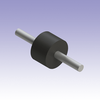
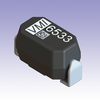
This chapter discusses semiconductor diodes and circuits. Topics include semiconductor materials, "ordinary" junction diodes, Zener diodes, Schottky-barrier diodes, PIN diodes, varactor diodes, step-recovery diodes, tunnel diodes, Gunn-effect diodes, IMPATT diodes, LEDs, IR laser diodes, and IR photodiodes.
Some of the information presented here is adapted from [1, 2].
17.1 Semiconductor Materials
Some of the following material is quoted or adapted from [1].
Semiconductors are materials that have electrical conductivities intermediate between those of metals and insulators, that is, they are "semi" conductors. These materials are found in column IV and neighboring columns of the periodic table. The column IV materials of interest are silicon (Si) and germanium (Ge), with Si being the most important, and are referred to as elemental semiconductors. The elements in column III of interest are boron (B), aluminum (Al), gallium (Ga), and indium (In). These elements are used as doping materials for Si or other semiconductor materials for producing p-type material. The elements in column V of interest are phosphorus (P), arsenic (As), and antimony (Sb). These elements are used as doping materials for Si or other semiconductor materials for producing n-type materials.
Compounds of materials from columns III and V make up part of the intermetallic or compound semiconductors. These III-V semiconductors include AlP, AlAs, AlSb, GaP, GaAs, GaSb, InP, InAs, InSb. Of these, gallium arsenide (GaAs) is the most important and has been used for microwave and higher frequency FET devices and Gunn diodes. GaAs has also been used for Schottky-barrier diodes, tunnel...
Copyright Artech House, Inc. 2005 under license agreement with Books24x7


 TABLE OF CONTENTS