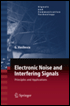
Electronic Noise and Interfering Signals: Principles and Applications
The chess board is the world; the pieces are the phenomena of the universe; the rules of the game are what we call the laws of Nature. The player on the other side is hidden from us. We know that his play is always fair, just and patient. But also we know, to our cost, that he never overlooks a mistake, or makes the smallest allowance for ignorance.
(T.H. Huxley)
Actually, noise is a term that is overused and sometimes misused. Many definitions have been proposed, referring either to the classical term or to terms emerging from nonconventional fields.
In the author s view, the most noteworthy definitions of noise (relating to electronic devices and circuit theory) are the following:
The IEEE Standard Dictionary of Electrical and Electronics Terms [1] defines noise (as a general term) as unwanted disturbances superposed upon a useful signal that tend to obscure its information content. This definition is versatile, since it applies both to intrinsic and extrinsic noise ( intrinsic noise is the noise generated inside a system, while the term extrinsic noise designates noise originating elsewhere).
A second definition, also presented in [1], states that noise is an undesired disturbance within the useful frequency band, with the stipulation that undesired disturbances within the useful frequency band produced by other services may be called interference. Although this formulation is equivalent to the previous ones, it has the merit of introducing a definition...