Electronic Noise and Interfering Signals: Principles and Applications
Chapter 16: Noise in Communication Systems

Noise is so great, that one cannot hear God Thunder

(Howell)

16.1 Attenuators

16.1.1 Underlying Principles

Definitions. According to [238]:

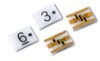
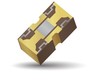
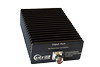
  • An attenuator is an adjustable passive network that reduces the power level of a signal without introducing appreciable distortion.

  • A pad (attenuating pad) is a nonadjustable passive network that reduces the power level of a signal without introducing appreciable distortion.

Comments

  • Usually pads and attenuators operate under matching conditions, i.e., the input and output impedances of the attenuator (pad) are matched to the impedances loading its terminals.

  • Often, the attenuation (or loss) introduced by the attenuator (pad) is denoted by L and expressed in decibels.

16.1.2 Case Studies

CASE STUDY 16.1 [243]

Prove the following theorem: the noise factor of any reciprocal, passive two-port is numerically equal to the loss of the two-port, i.e.,


where G a is the available power gain and L the loss. Comment on the conditions under which this equality holds.

Solution

According to (5.13), the input noise temperature of the matched attenuator is


where T is the attenuator temperature. On the other hand, expression (4.77) establishes an equivalence between the input noise temperature and the noise factor of any two-port:


Equating the previous expressions for T e, we have


At T = T o = 290 K, we obtain


Another implicit condition to be satisfied in order to ensure the validity of the theorem is that the input termination of the two-port must also have a...

UNLIMITED FREE
ACCESS
TO THE WORLD'S BEST IDEAS

SUBMIT
Already a GlobalSpec user? Log in.

This is embarrasing...

An error occurred while processing the form. Please try again in a few minutes.

Customize Your GlobalSpec Experience

Category: RF Attenuators
Finish!
Privacy Policy

This is embarrasing...

An error occurred while processing the form. Please try again in a few minutes.