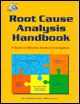
Root Cause Analysis Handbook: A Guide to Effective Incident Investigation, 2005 Edition
The root cause analysis system presented in this handbook is designed for use in investigating and categorizing the root causes of events with safety, health, environmental, quality, reliability, and production impacts, although the examples used in this handbook are predominantly those having safety and health impacts. The term "event" is used to generically identify events that have these types of consequences. The SOURCE (Seeking Out the Underlying Root Causes of Events) methodology is based on one developed for the Department of Energy by the Westinghouse Savannah River Corporation in 1991.
Root cause analysis is simply a tool designed to help investigators (1) describe WHAT happened during a particular occurrence, (2) determine HOW it happened, and (3) understand WHY it happened. Only when investigators are able to determine WHY an event or failure occurred will they be able to specify workable corrective measures.
Most event analysis systems allow investigators to answer questions about what happened during an event and about how the event occurred, but often they are not encouraged to determine why the event occurred. Imagine an occurrence during which an operator is instructed to close Valve A; instead, the operator closes Valve B. The typical investigation would probably result in the conclusion that "operator error" was the cause of the occurrence. This is an accurate description of what happened and how it happened. An operator committed an error by manipulating the wrong valve. If the analysts stop at this level of analysis, however, they...