SFPE Engineering Guide on Fire Exposures to Structural Elements
Fully Developed Enclosure Fires

OVERVIEW

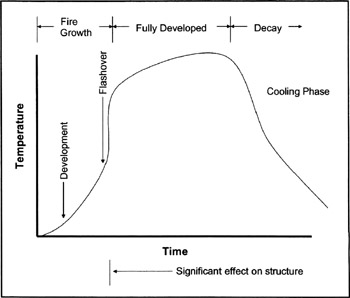
Fire in enclosures may be characterized in three phases. The first phase is fire growth, when a fire grows in size and heat release rate from a small incipient fire. If there are no actions taken to suppress the fire, it will eventually grow to a maximum size, which is a function of the amount of fuel present or the amount of air available through ventilation openings. As all of the fuel is consumed, the fire will decrease in size (decay). These stages of fire development can be seen in Figure 1.


Figure 1: Phases of Fire Development

The size (magnitude) of the fire and the relative importance of these phases (growth, fully developed, and decay) are affected by the size and shape of the enclosure; the amount, distribution, form, and type of fuel in the enclosure; the amount, distribution, and form of ventilation of the enclosure; and the form and type of materials forming the roof (or ceiling), walls, and floor of the enclosure.

The significance of each phase of an enclosure fire depends on the fire safety system component under consideration. For components such as detectors or sprinklers, the fire growth part is likely to be the most significant because it will have a great influence on the time at which they activate. The fire growth stage usually proves no threat to the structure, but if it can (for example, if concentrated fuel packets are located close to an element), the direct heating by flames must be...

UNLIMITED FREE
ACCESS
TO THE WORLD'S BEST IDEAS

SUBMIT
Already a GlobalSpec user? Log in.

This is embarrasing...

An error occurred while processing the form. Please try again in a few minutes.

Customize Your GlobalSpec Experience

Category: Fire Protection Services
Finish!
Privacy Policy

This is embarrasing...

An error occurred while processing the form. Please try again in a few minutes.