SFPE Engineering Guide on Fire Exposures to Structural Elements
RECOMMENDATIONS

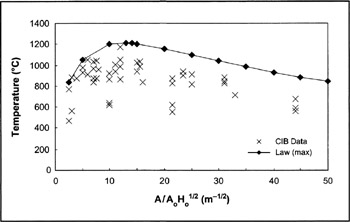
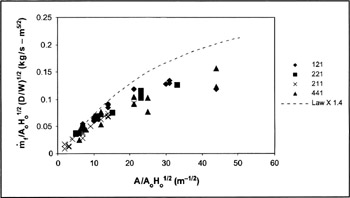
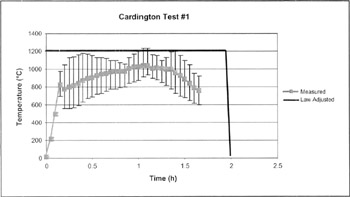
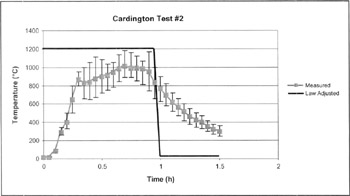
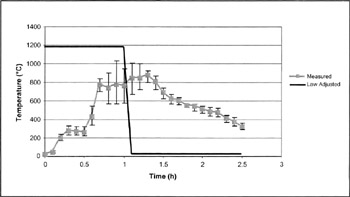
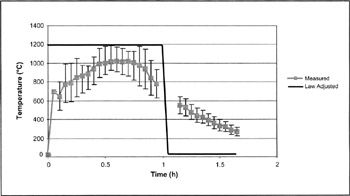
Based on comparison of predictions to the data from the CIB and Cardington tests, Law's method is recommended for use in all roughly cubic compartments (compartment width to depth ratio within the range of 0.5 to 2.0) and in long, narrow compartments where does not exceed 18 m -1/2. To ensure that predictions are sufficiently conservative in design situations, the predicted burning rate should be reduced by a factor of 1.4, and the temperature adjustment should not be reduced by the factor ?. See Figures 12 through 17, which show comparisons made using Law's method to the CIB data and to data for Cardington tests


Figure 12: Comparison of CIB Temperature Data to Predictions Using Law's Method

Law's method does not predict temperatures during the decay stage. For cases where a prediction of temperatures during the decay stage is desired, a decay rate of 7 C/min can be used for fires with a predicted duration of 60 minutes or more, and a decay rate of 10 C/min can be used for fires with a predicted duration of less than 60 minutes.


Figure 13: Comparison of CIB Burning Rate Data to Predictions Using Law's Method

Figure 14: Comparison of Predictions Using Law's Modified Method for Cardington Test #1

Figure 15: Comparison of Predictions Using Law's Modified Method for Cardington Test #2

Figure 16: Comparison of Predictions Using Law's Modified Method for Cardington Test #8

Figure 17: Comparison of Predictions Using Law's Modified Method for Cardington Test #9

For...

UNLIMITED FREE
ACCESS
TO THE WORLD'S BEST IDEAS

SUBMIT
Already a GlobalSpec user? Log in.

This is embarrasing...

An error occurred while processing the form. Please try again in a few minutes.

Customize Your GlobalSpec Experience

Category: Automation Controls Design and Installation Services
Finish!
Privacy Policy

This is embarrasing...

An error occurred while processing the form. Please try again in a few minutes.