SFPE Engineering Guide on Fire Exposures to Structural Elements
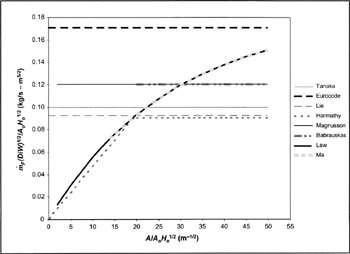
As can be seen in Figure A. 1, predictions of burning rate vary markedly among the different methods. Some of the methods assume stoichiometric or ventilation-limited burning, while others account for fuel-controlled burning.
From Equation 20 similar results can be derived:
or
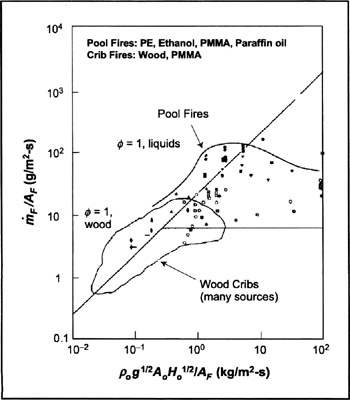
The pool fire results are explained by the stoichiometry and thermal feedback.
The locus of 
s and
both are larger for liquids compared to wood.
In the CIB experiments the fuel is placed over the entire floor; therefore, A F ? A.
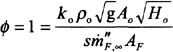
Here the theory gives
From Equation 26, for ![]()
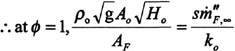
for
which agrees with the trends in Figure A.2.
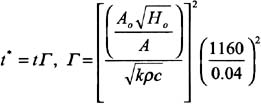
The Eurocode prescribes
Here t* is essentially Q w *?2
or
only
This specification must assume a ventilation-limited fire and ignores the other variables.
Only a ventilation-limited fire is assumed.
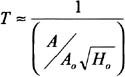
Lie gives
.
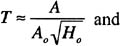
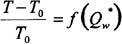
The theoretical development gives
For temperature, T = f(F, t) and C, a constant which takes into account the properties of the bounding materials of the enclosure.
This represents kpc since k ~ p.
Magnusson, Thelandersson, and Petersson compute a result for temperature based on a similar theory. They augment it with a rate of rise for developing fire and a prescribed cooling phase. They use only the ventilation-controlled...