Sheet Metal Forming Processes and Die Design

Bending dies may be conveniently classified according to their design, whether simple or complex, and according to their universality of application, whether universal or specific. The design of bending dies depends on the complexity of the workpiece shape, its dimensions, the type of material, the tolerances, etc.
Some die sets are designed to perform a single bending operation, which may include V, L, U, or Z, bends and other profiles. Such dies are called single-operation dies or simple dies. One operation is accomplished with each stroke of the press.
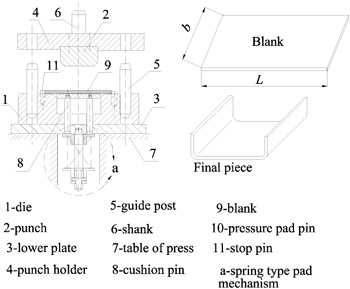
Fig. 10.1 illustrates a simple die for bending a U-profile. In this example, the blank of length L, width b, and thickness T, is positioned on the die (1) between stop pins (11). The die (1) is mounted on the lower plate (3) in the conventional position. The punch (2) is attached to the punch holder (4), which is fitted a shank (6) for that purpose, to the ram of the press. The pressure pad (10) applies pressure to the blank so that as the punch pushes the blank into the die, the workpiece is formed by a single stroke of the press. The bent workpiece is ejected from the die by the pressure pad mechanism (a) when the press ram retracts. For bending workpieces of small dimensions and thin material, the punches and dies are made from a single block of metal.