Signal Processing Applications in CDMA Communications
4.2: Uplink

4.2 Uplink

Consider the antenna array CDMA system described in (1.13). In the presence of noise, the baseband signal received at the mth receiver is given by:

(4.1)
The additive noise { v m( t)} is assumed to be of power ? n 2 and is independent to the signals.

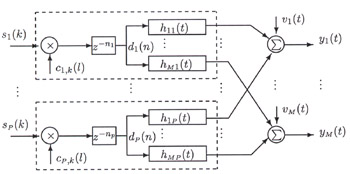
To facilitate our analysis, we shall cast the above CDMA system into a multi-input multi-output (MIMO) framework of Figure 4.1, with { d i( n)} denoting the spread chip sequences and { h mi} the composite channel responses of maximum length L cT c The antenna outputs can be expressed in vector convolution form below:

(4.2)
where h i( t) = [ h 1 i( t) h Mi( t)] T and v( t)= [ v 1( t) v M( t)] T represent the noise vector.


Figure 4.1: Antenna array CDMA with aperiodic spreading sequences.

Note the modulated chip sequence from the ith user:

(4.3)
The chip delay index n i, 0 ? n i < L, accounts for the relative discrete-time offset between users. In practice, this offset is usually known to the receiver after coarse synchronization during the initial access. The exact timing (within a fraction of a chip duration) of the direct-path signal, incorporated in h i(t) is assumed to he unknown.

Sampling each antenna output at the chip...

UNLIMITED FREE
ACCESS
TO THE WORLD'S BEST IDEAS

SUBMIT
Already a GlobalSpec user? Log in.

This is embarrasing...

An error occurred while processing the form. Please try again in a few minutes.

Customize Your GlobalSpec Experience

Category: Antennas
Finish!
Privacy Policy

This is embarrasing...

An error occurred while processing the form. Please try again in a few minutes.