Signal Processing Applications in CDMA Communications
A short but very dense discussion of engineering techniques for
solving problems in CDMA wireless systems.
 TABLE OF CONTENTS
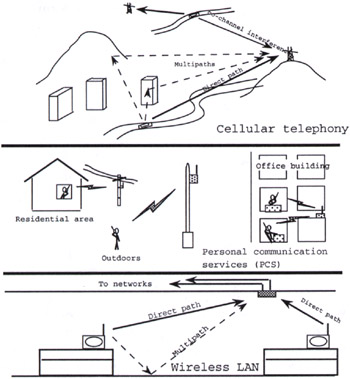
 The steadily decreasing cost of wireless communications and its growing deployment have resulted in its increased popularity. In the past decade, wireless personal communication services (PCS) have grown from a vague concept to an important global telecommunication service with over 300 million subscribers. Existing services range from cellular telephony to wireless local loops (WLL) to indoor/outdoor wireless local-area networks (WLAN); see Figure 1.1. Future trends include a wireless infrastructure supporting an integrated mix of multimedia traffic. This unprecedented demand for a new mode of telecommunications has led to a great deal of progress in the past 20 years.
An important challenge in wireless system design is the selection of an appropriate multiple-access scheme. Among many multiple-access strategies that have been developed [1], direct-sequence code-division multiple-access (DS-CDMA) has emerged as a major scheme for current PCS systems and a final candidate for the air interface of the third-generation (3G) universal wireless personal communication network planned for the next century [1, 2]. CDMA radio systems provide several advantages in terms of network planning, graceful degradation under loaded conditions, soft handoff, and path diversity that are fundamental to boosting quality of service and overall capacity.
A vast literature on the topic of CDMA exists, including entire texts on general CDMA [3] and some on the popular IS-95 standard [4]. However, the full potential of CDMA communication, underlined by the continuous growing interest and research activities in this area, is yet to be exploited. The purpose of this chapter...