Signal Processing Applications in CDMA Communications
A short but very dense discussion of engineering techniques for
solving problems in CDMA wireless systems.
 TABLE OF CONTENTS
 In most existing CDMA systems, the same detection schemes are used in both uplink and downlink. Since downlink CDMA signals possess some intrinsic structures that are not available in uplink. we will discuss in the remainder of this chapter high-performance downlink signal reception by exploiting structural information.
In CDMA downlink, all users' signals are transmitted synchronously. By setting the relative delays to zero in (1.2), we obtain the expression for downlink CDMA signal as:
| (4.35) |  |
In downlink modulation, individual data sequences are first spread by orthogonal spreading codes (e.g., the Walsh codes). The spread sequences are then combined and overlaid with a long pseudorandom mask code. The lth chip within the kth symbol can thus be decomposed as:

| (4.36) | 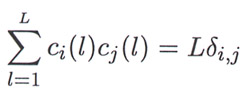 |
For general purposes,...