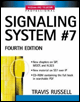
Signaling System #7, Fifth Edition

Chapter 4: Overview of Signal Units

Overview of Signal Units

There are three basic methods of switching in a network: circuit switching, message switching, and packet switching. Circuit switching uses a physical connection between two entities for transmitting a data stream. The circuit remains connected until both entities have completed the transmission. A good example of a circuit-switching network is the Public Switched Telephone Network (PSTN).

Message switching came about in the 1970s and 1980s and uses a message structure to route data through a network. The data are accompanied by an address and a message (which serves as an instruction to the receiver). The data are sent in their entirety and do not include any error-checking schemes or flow control.

Packet switching arranges the data into a packet or a group of packets and transmits them in the form of a complete packet, providing all the information needed to route and process the received data. Network management and error detection/correction are included in packet-switching networks.

Signaling System 7 (SS7) is a packet-switching technology and uses data packets just like X.25 and other packet-switching technologies. A packet contains all the information necessary to route data through a network without establishing a connection to the destination.

Packet switching is a more efficient way of networking, and it makes better use of facilities. In the event of network failures or any other problems in the network, the packet protocol can change the routing for a particular destination dynamically and can provide higher reliability...

UNLIMITED FREE
ACCESS
TO THE WORLD'S BEST IDEAS

SUBMIT
Already a GlobalSpec user? Log in.

This is embarrasing...

An error occurred while processing the form. Please try again in a few minutes.

Customize Your GlobalSpec Experience

Category: Packet Switching Chips
Finish!
Privacy Policy

This is embarrasing...

An error occurred while processing the form. Please try again in a few minutes.