Signaling System #7, Fifth Edition

ISUP Message Formats

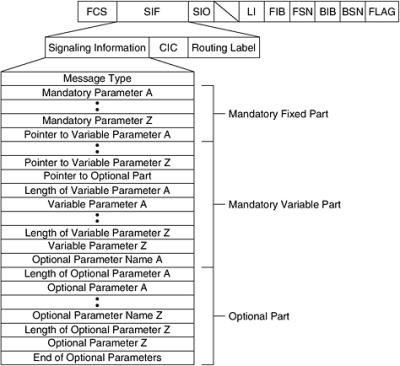
The ISUP protocol uses message types to indicate the type of message being carried as well as the format of the message. Each message type has a distinct format that has mandatory and optional parameters (Figure 8.10). The parameters depend on the message type.


Figure 8.10: The components and format used for ISUP messages.

As in the TCAP protocol, the ISUP uses mandatory fixed parts and mandatory variables. These are parameters that always must exist, depending on the type of ISUP message. Again, the parameters used depend on the message type.

Circuit Identification Code (CIC)

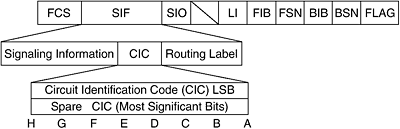
The circuit identification code (CIC) identifies the circuit that is being set up or released (Figure 8.11). The CIC may be a voice trunk or any other transmission medium in the PSTN.


Figure 8.11: The CIC is used to identify the trunk circuit that will be connected and associated with this message. The CIC is not used in broadband services. Instead, virtual paths and virtual connections are identified in the BISUP message content.

Currently, there are no defined standards for allocating circuit identifiers. These are determined by an agreement between the telephone companies. The CIC is provided to the originator of the ISUP message (SSP) by the end switch. The end switch may be incorporated into the SSP because many of these systems are fully integrated. This means that a voice subsystem provides the switching functionality for the voice circuits, whereas the SS7 subsystem provides all the circuit control.

UNLIMITED FREE
ACCESS
TO THE WORLD'S BEST IDEAS

SUBMIT
Already a GlobalSpec user? Log in.

This is embarrasing...

An error occurred while processing the form. Please try again in a few minutes.

Customize Your GlobalSpec Experience

Category: Pagers
Finish!
Privacy Policy

This is embarrasing...

An error occurred while processing the form. Please try again in a few minutes.