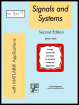
Signals and Systems with MATLAB Applications, Second Edition
Chapter 11: Analog and Digital Filters

This chapter is an introduction to analog and digital filters. It begins with the basic analog filters, transfer functions, and frequency response. The amplitude characteristics of Butterworth and Chebychev filters and conversion of analog to equivalent digital filters using the bilinear transformation is presented. It concludes with design examples using MATLAB.

11.1 Filter Types and Classifications

Analog filters are defined over a continuous range of frequencies. They are classified as low-pass, high-pass, band-pass and band-elimination (stop-band). The ideal amplitude characteristics of each are shown in Figure 11.1. The ideal characteristics are not physically realizable; we will see that practical filters can be designed to approximate these characteristics.


Figure 11.1: Amplitude characteristics of the types of filters

Another, less frequently mentioned filter, is the all-pass or phase shift filter. It has a constant amplitude response but is phase varies with frequency. Please refer to Exercise 4.

A digital filter, in general, is a computational process, or algorithm that converts one sequence of numbers representing the input signal into another sequence representing the output signal. Accordingly, a digital filter can perform functions as differentiation, integration, estimation, and, of course, like an analog filter, it can filter out unwanted bands of frequency.

Analog filter functions have been used extensively as prototype models for designing digital filters and, therefore, we will present them first.

UNLIMITED FREE
ACCESS
TO THE WORLD'S BEST IDEAS

SUBMIT
Already a GlobalSpec user? Log in.

This is embarrasing...

An error occurred while processing the form. Please try again in a few minutes.

Customize Your GlobalSpec Experience

Category: IC Electronic Filters
Finish!
Privacy Policy

This is embarrasing...

An error occurred while processing the form. Please try again in a few minutes.