11.3 Low-Pass Analog Filters
In this section, we will use the analog low-pass filter as a basis. We will see later that, using transformations, we can derive high-pass and the other types of filters from a basic low-pass filter. We will discuss the Butterworth, Chebyshev and Cauer ( elliptic) filters.
The first step in the design of an analog low-pass filter is to find a suitable amplitude-squared function A 2( ?), and from it derive a G( s) function such that
Since ( j ?)* = ( ? j ?), the square of the magnitude of a complex number can be expressed as that number and its complex conjugate. Thus, if the magnitude is A, then
Now, G( j ?) can be considered as G( s) evaluated at s = j ?, and thus (11.7) is justified. Also, since A is understood to represent the magnitude, it needs not be enclosed in vertical lines.
Not all amplitude-squared functions can be decomposed to G( s) and G ( ? s) rational functions; only even functions of ?, positive for all ?, and proper rational functions [*] can satisfy (11.7).
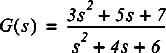
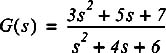
Example 11.4 It is given that
Compute A 2( ?).
Solution:
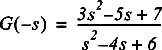
Since
it follows that
and
Therefore,
The general form of the amplitude square function A 2( ?) is
where C is the...

 TABLE OF CONTENTS