Six Sigma for Electronics Design and Manufacturing

Six sigma is focused on the production defect rate or first time yield (FTY) prediction based on the interaction of the process parameters versus the specified tolerance. This 1.5 ? average shift that is allowed under certain definitions of six sigma has led to confusion over defect and FTY calculations. The definition of Cpk attempts to rectify this condition: it is the minimum of the two halves of the distribution interaction of the specifications versus the manufacturing distribution. A capability constant k is provided to calculate Cpk:
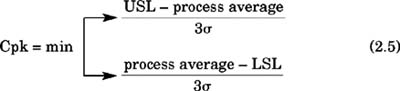
A more direct method for calculating Cpk is to divide the two halves of the distribution as to their interaction with the specification limits:
When the average shift of the process from specification nominal is equal to zero, then the Cp and Cpk terms are equal.
where
Cp is the process capability index
k is the Cpk constant
USL and LSL are the upper and lower design specifications limits in units of geometry (mm) or output (volts)
SL is the specification limit interval equal to USL or LSL minus the nominal
? is the standard deviation of the manufacturing process
In the design community, Cp = 1 is also called 3 ? design, and Cp = 1.33 is called 4 ? design.
When there is a manufacturing process average shift, the value of Cpk is not equal to the value of Cp. Using Equation...