Smoke, Dust, and Haze: Fundamentals of Aerosol Dynamics, Second Edition

PROBLEMS

13.1

The size distribution function n d( d p) ? ? N/ ? d p for the Pasadena aerosol averaged over the measurements in August and September 1969 is shown in the table.

  1. Determine the mean particle diameter in micrometers.

  2. Determine the mass median particle diameter that is, the diameter for which the mass of the larger particles is equal to the mass of smaller particles.

  3. Estimate the total surface area of particulate matter per unit volume of air corresponding to this distribution.

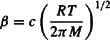
  4. Many of the constituents of photochemical smog, such as free radicals, are highly reactive. Assume that such species are destroyed on striking a surface. Estimate the time for the concentration of such species to decay to one-tenth of their original value in the atmosphere if they are destroyed and not replaced on striking the aerosol surfaces. Assume that the rate at which molecules in a gas collide with a surface is given by the kinetic theory expression,

where M is the molecular weight of colliding species = 100 g/mole (assumed), R is the gas constant (8.3 10 7 ergs/K mole), T is the absolute temperature (300 K, assumed), and c is the concentration of reactive species.

  1. Show that the power law form of the size distribution function holds approximately for the data, and evaluate the constant of proportionality and its dimensions.

  2. Compare the self-preserving size distribution for coalescing spheres with the data for the accumulation mode. For this...

UNLIMITED FREE
ACCESS
TO THE WORLD'S BEST IDEAS

SUBMIT
Already a GlobalSpec user? Log in.

This is embarrasing...

An error occurred while processing the form. Please try again in a few minutes.

Customize Your GlobalSpec Experience

Category: Particle Analyzers
Finish!
Privacy Policy

This is embarrasing...

An error occurred while processing the form. Please try again in a few minutes.