SMS and MMS Interworking in Mobile Networks

The one who falls in a fight for liberty never dies.
Christo Botev
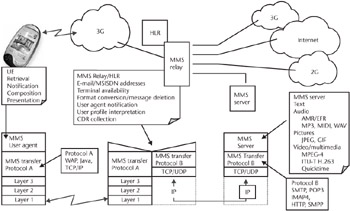
MMS technology has been introduced with the development of GPRS networks and handsets (Figure 9.1). GPRS allows any handset to exchange data with a network entity through a packet-designed protocol on a multiple traffic channel (TCH) circuit. Then, depending on the network and handset capabilities, the throughput of data exchange can reach up to 64 Kbps. Typically, on most deployed GSM networks providing GPRS technology and also on most GPRS handsets, the bit rate is approximately 40 Kbps. (Handheld phones use only 4 TCH among all those available.)
With this new technology it became possible for an MS to send more sophisticated data than SMSs to the network entities. MMS technology was introduced to provide GSM subscribers with the ability to send messages that are a combination of text, images or video, and sounds.
MMS technology introduces the entities discussed in the following sections in the multimedia messaging service environment (MMSE), as depicted in Figure 9.1.
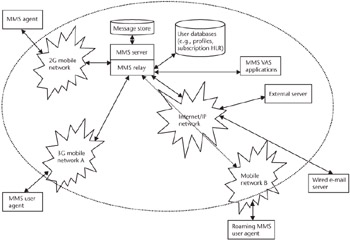
The MMS relay/server (Figure 9.2) is a network entity or application controlled by the MMS provider. It brings to the network the ability to transfer messages, store them, or provide any specific operations needed by the mobile environment. This entity transcodes and delivers messages to mobile subscribers. The server provides the store and store-and-forward architecture.