Standard Handbook of Biomedical Engineering and Design

Bruce C. Towe
Arizona State University, Tempe, Arizona
Bioelectricity is fundamental to all of life s processes. Indeed, placing electrodes on the human body, or on any living thing, and connecting them to a sensitive voltmeter will show an assortment of both steady and time-varying electric potentials depending on where the electrodes are placed. These biopotentials result from complex biochemical processes, and their study is known as electrophysiology. We can derive much information about the function, health, and well-being of living things by the study of these potentials. To do this effectively, we need to understand how bioelectricity is generated, propagated, and optimally measured.
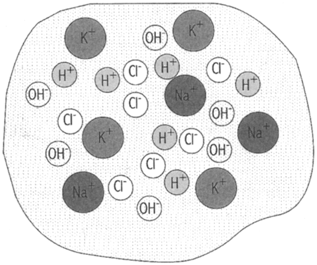
In an electrical sense, living things can be modeled as a bag of water having various dissolved salts. These salts ionize in solution and create an electrolyte where the positive and negative ionic charges are available to carry electricity. Positive electric charge is carried primarily by sodium and potassium ions, and negative charges often are carried by chloride and hydroxyl. On a larger scale, the total numbers of positive and negative charges in biological fluids are equal, as illustrated in Fig. 17.1. This, in turn, maintains net electroneutrality of living things with respect to their environment.
Biochemical processes at the...