Standard Handbook of Biomedical Engineering and Design
James P. O Leary
Tufts University, Medford, Massachusetts
The design of a medical product is a complex task. All design activities involve the resolution of conflicts and compromise among the desired features, but in medical products the conflicts tend to be more intense, the stakes are often higher, and the background information is often more uncertain. This section describes a process that has been found to be useful in bringing successful products to market. It is based on an approach to design that has recently been described as concurrent engineering.
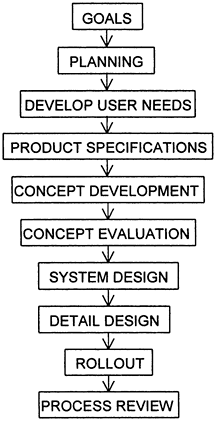
This section opens with some groundwork on getting a program started, follows that with a somewhat specific set of steps to be carried out as the design is developed (Fig. 19.1), and then examines some issues that pervade the entire process, reviewing how these concerns might affect a design and in particular the design of a medical device. Figure 19.1 shows the steps in the process to be described.
In order to be more specific about some of the details, an example is sometimes necessary. In this section that product is an improved system of exterior fixation of long bone fractures. In exterior fixation, pins of some type are attached through the skin to the bones above and below the fracture and these pins are in turn attached to an external structure that maintains the position of the bone segments during healing. This is a problem that is easy...