Standard Handbook of Plant Engineering, Third Edition

Packed with tables, formulas, charts, graphs, and checklists, this guide offers you the cutting-edge information you need to keep your plant operating at peak efficiency and profitability.
 TABLE OF CONTENTS
 Simpson Electric Company
Elgin, Illinois
Electrical measuring instruments are important to all aspects of plant maintenance and control. Some tasks require only simple yes or no checks, e.g., continuity, presence or absence of line power voltage, and current flow. Instruments for these tests may be rugged and inexpensive. Yet they must be safe, reliable, and accurate. Whether you are working on the production line, in the laboratory, or servicing equipment, measurements can yield cost savings proportional to instrument accuracy. Electrical measuring equipment is available in three basic configurations: handheld, bench-mounted, and panel-mounted. The following paragraphs in this chapter provide: (1) overviews of uses for electric and electronic measuring instruments, (2) guides to the safe operation of these instruments, and (3) criteria for selecting particular instrument features.
[*] Revised for this third edition.
There is a need for electrical measurement everywhere in the plant:
Incoming component inspection
Production line assembly
Quality control
Plant maintenance and repair
Power monitoring and conservation
Popular with manufacturing and service professionals alike, the most versatile test instrument is the multimeter, combining measurement of ac and dc voltage, resistance (ohms), and current (amperes). Usually compact, battery-powered, and portable, two types of multimeter are widely available: the analog volt-ohm-milliammeter (VOM) and the digital multimeter (DMM).
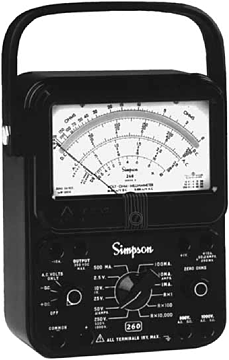
The analog volt-ohm-milliammeter (Fig. 5.1) is basically a test instrument, with several ranges for measuring volts, ohms, and amperes. The VOM consists of:
An...