Standard Handbook of Plant Engineering, Third Edition

Packed with tables, formulas, charts, graphs, and checklists, this guide offers you the cutting-edge information you need to keep your plant operating at peak efficiency and profitability.
 TABLE OF CONTENTS
B. W. Elliott Manufacturing Co., LLC
Binghamton, New York
Flexible shafting is a direct, mechanical method for transmitting rotary power or motion between two points through a simple or complex path. In its many applications, flexible shafting has simplified and/or replaced conventional methods of power or motion transmittal such as gears, belts, pulleys, and universal joints.
The benefits of using (Fig. 5.63) flexible shafting are becoming increasingly apparent to design engineers familiar with its capabilities. Flexible shafting provides a high degree of freedom in locating transmission system components and dramatically reduces or eliminates the need for precise alignment between driving and driven shafts. It is relatively unaffected by vibration, highly efficient (80 to 95 percent) and, being intrinsically safe, does not require expensive safety guards. It solves space- and weight-related problems and operates where temperatures, chemical and biological contaminants, or nuclear radiation is a primary design consideration.
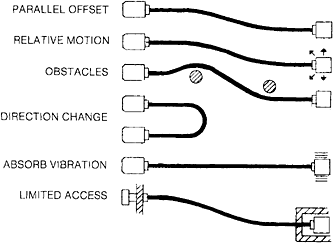
When mounting a motor to drive a pump, a gearbox, or any device with self-contained bearings, a conventional coupling can absorb only small amounts of misalignment [typically less than 2 in angularity and 0.005 in (0.13 mm) in parallel misalignment]. The large tolerance for misalignment inherent in the flexible shaft allows the production engineer to do away with time-consuming and expensive realignment requiring dial indicators every time a motor is removed and replaced.
Use in printing machinery and paper-coating equipment, or whenever power must...