Standard Handbook of Video and Television Engineering, 4th Edition

Chapter 9.8: Video Signal Processing

James Michener, Robert Jull

9.8.1 Introduction

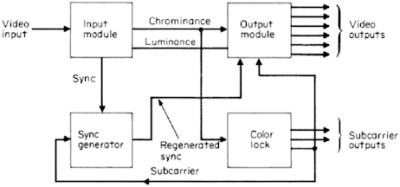
Video processing amplifiers, or proc amps, are high-performance video amplifiers that regenerate the sync, blanking, and subcarrier portions of the video signal. Video processors are typically used to improve noisy video signals, to provide stable and standard video inputs to video tape recorders (VTRs), studio systems, network distribution services, and transmitters. In addition, special proc amps are used for more complex processing applications such as image enhancement, gamma correction, and automatic white- and black-level control. Figure 9.8.1 is a simplified block diagram of a typical video processing system.


Figure 9.8.1: Video processor simplified block diagram.

9.8.2 Video Processing System Development

During the early monochrome television years, a primary concern was the problem of variations in the sync level that occurred when switching between video sources. Because the peak power of the visual transmitter was determined by the peak sync amplitude, source signals with higher than normal sync amplitude could cause over-load of the transmitter, and protection circuits would shut down the transmitter. In order to avoid this type of service interruption, the first video processing amplifiers were used as sync (amplitude) stabilizing amplifiers, or stab amps. Both clipping- and regenerative-type stab amps are still in use today in many applications. The early sync stab amp designs were essentially a threshold-sensitive stretch-and-clip type of sync processor. A sync amplifier, followed by a sync clipper, was used to maintain a fixed sync output amplitude. A threshold control was used to adjust the sync gain.

UNLIMITED FREE
ACCESS
TO THE WORLD'S BEST IDEAS

SUBMIT
Already a GlobalSpec user? Log in.

This is embarrasing...

An error occurred while processing the form. Please try again in a few minutes.

Customize Your GlobalSpec Experience

Category: Logarithmic Amplifier Chips
Finish!
Privacy Policy

This is embarrasing...

An error occurred while processing the form. Please try again in a few minutes.