Standard Handbook of Video and Television Engineering, 4th Edition

Michael Betts, James E. Blecksmith, Bruce Rayner
Video production systems include equipment that switches, modifies, or creates video for the purpose of enhancing program material supplied by cameras, VTRs, or other outside sources. Typical production devices and their interfaces are shown in the video system block diagram in Figure 9.10.1.
A video production switching system (switcher) is one of the primary devices used to produce a television program. Production switchers are essential to all live operations and most postproduction situations. The main function of a production switcher is to either switch or cut between two video sources, or combine them in a variety of ways. The principal methods used to combine video are:
Mixing
Wiping
Keying
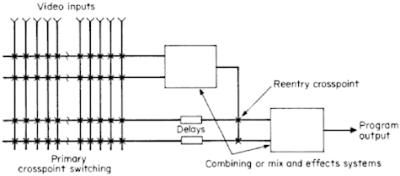
A production switcher consists of two main sections:
An input selection matrix which provides the input switcher functions
Video mixing amplifiers, usually called the mix and effects (mix/effects) system, which provides the combining functions
Early systems could only switch or mix video sources using an input selection matrix and a simple mixing amplifier, which selected the proportions of the two video signals being combined and added the result to form the output signal. In Europe, video switchers were patterned after audio mixers where the amplitude of each input was controlled by a separate control (knob), allowing two or more signals to be combined simultaneously.
As technological advances provided high-speed switching transistors and integrated circuits, wipe and...