Stormwater Collection Systems Design Handbook

Flows in sewers usually are open-channel flows with a free water surface. However, sewer pipes, culverts, and similar conduits under high flow could become surcharged and pressurized conduit flows do occur. Strictly speaking, the flow is always unsteady, that is, changing with time. Nevertheless, in a number of situations, such as in most cases of flow in sanitary sewers and for some rainstorm runoffs, change of flow with time is slow enough that the flow can be regarded as time-stepwise approximately steady.
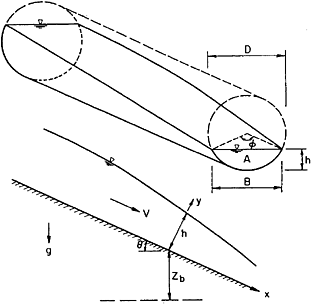
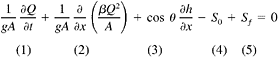
Unsteady sewer flow with a free surface, as in Fig. 6.7, can be described by a momentum equation which is given below in both velocity (nonconservative) and discharge (conservative) forms:
| (6.3) | |
| (6.4) | |
where <i class="emphasis">x </i>= longitudinal direction of sewer<i class="emphasis"> A </i>= flow cross-sectional area normal to <i class="emphasis">x</i><i class="emphasis"> y </i>= coordinate direction normal to <i class="emphasis">x</i> on a vertical plane<i class="emphasis"> h </i>= depth of flow of the cross section, measure along y direction<i class="emphasis"> Q </i>= discharge through <i class="emphasis">A</i><i class="emphasis"> V </i>= <i class="emphasis">Q</i>/<i class="emphasis">A</i>, cross-sectional average velocity along x direction<i class="emphasis"> S</i><sub<i class="emphasis">o </i></sub>= channel slope, equal...