Stormwater Collection Systems Design Handbook

Larry W. Mays
Department of Civil and Environmental Engineering
Arizona State University
Tempe, Arizona
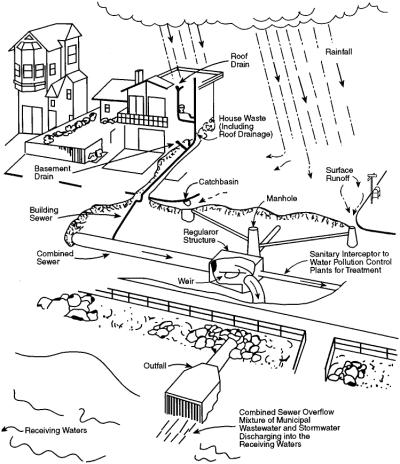
Sewer systems that convey both sanitary sewerage and stormwater through a single pipe are referred to as combined sewer systems (CSSs). During dry weather a CSS is able to convey all flows to the waste water treatment plant. However, during periods of heavy rainfall or wet weather flow (WWF), the CSS capacity may be exceeded, resulting in a combination of untreated sewage and stormwater flowing in the same pipe(s), and may be discharged directly into nearby receiving water. These overflows are referred to as combined sewer overflows (CSOs). Manuals on CSO control have been published by the Water Environment Federation (WEF) (1989) and the U.S. Environmental Protection Agency (USEPA) (1993).
Retention storage facilities capture and dispose stormwater runoff through infiltration, percolation, and evaporation, whereas detention storage is temporary storage for stormwater runoff and CSO. In CSOs, temporarily stored flows are subsequently returned to the sewerage system at a reduced rate of flow, or the flow is discharged to a receiving water with or without treatment. The common elements of a typical CSS that are generally found in older cities are illustrated in Fig. 18.1.
The solution to WWF problems most often include a combination of best management practices (BMPs). The backbone of integrated WWF management plans should be storage...