Basics for Sewer Design
The most important components of an urban storm drainage system are the storm sewers. A number of methods exist for designing the size of such sewers. Some are hydraulically highly sophisticated, using the Saint-Venant equations, whereas others are relatively simple. Occasionally, a sophistaticated method is used to design one or a few sewer pipes. Each pipe has its own design storm of specified duration. Hence, the design computation is repeated for different pipes in a network, making the method inefficient for large networks with many sewers. Conversely, the simple methods, particularly the rational method, which does not require re-computation of the flow in upstream sewers, offer a practical option that is used often. In contrast, using the models for storm runoff prediction/simulation hydraulically sophisticated storm sewer design methods do not necessarily provide a better design than the simpler methods, mainly because of the discrete sizes of commercially available sewer pipes.
If the peak design discharge, Q p, for a sewer is known, the required sewer dimensions can be computed by using Manning s formula, Eq. (6.36) or the Darcy-Weisbach formula, Eq. (6.37), which are obtained from Eq. (6.8) or (6.9) by assuming that the friction slope, S f, is equal to the sewer slope, S o. For a circular sewer pipe, the minimum required diameter, d r, is
| (6.42) | 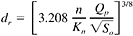
|
in which k n = 1 for SI units and 1.486 for English units. If the...


 TABLE OF CONTENTS