Structural Steel Designer's HandBook: AISC, AASHTO, AISI, ASTM, AREMA, and ASCE-07 Design Standards, Fourth Edition

The AASHTO Standard Specifications for Highway Bridges allow load factor design (LFD) as an alternative method to allowable stress design for design of simple and continuous beam and girder structures of moderate length, and it is widely used for highway bridges.
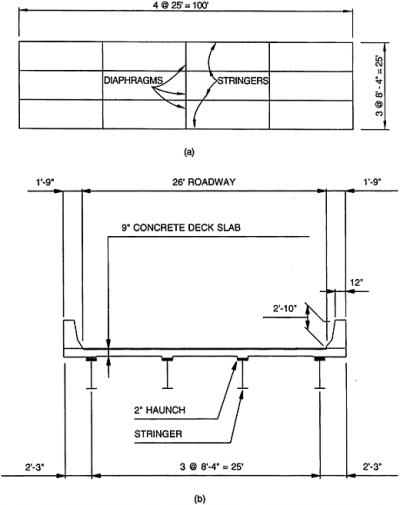
Load factor design is a method of proportioning structural members for multiples of the design loads. The moments, shears, and other forces are determined by assuming elastic behavior of the structure. To ensure serviceability and durability, consideration is given to control of permanent deformations under overloads, to fatigue characteristics under service loadings, and to control of live-load deflections under service loadings. To illustrate load factor design, a simply supported, composite, plate-girder stringer of a two-lane highway bridge will be designed. As indicated in the framing plan, Fig. 12.13a, the stringers span 100 ft c to c of bearings. The typical cross section, Fig. 12.13b, shows a 26-ft-wide roadway flanked by 1-ft 9-in-wide barrier curbs.
| ( a) For dead loads, n = 24 | ||||||
|---|---|---|---|---|---|---|
| Material | A | d | Ad | Ad 2 | I o | I |
| Steel section | 55.8 | ?168 | 35,170 | |||
| Concrete 100 8.5/24 | 35.4 | 37.0 | 1,310 | 48,470 | 210 | 48,680 |
| 91.2 | 1,142 | 83,850 | ||||
| d 24 = 1,142/91.2 = 12.52 in | ?12.52 ... |