The Structure and Rheology of Complex Fluids
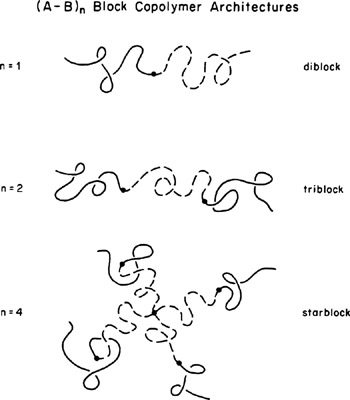
Block copolymers are made of two or more chemically distinct sequences, or polymeric "blocks" (see Fig. 13-1) (Molau 1971; Aggarwal 1976; Folkes 1985; Bates and Fredrickson 1990) The simplest type of block copolymer is the diblock, which contains a sequence of type "A" monomers covalently bonded to a sequence of type "B" monomers. A triblock copolymer contains three blocks. Two of these blocks can be chemically the same, as in an ABA triblock, or all three can be different, as in an ABC triblock copolymer. Obviously, the number of possible block sequences increases rapidly with the number of blocks and the number of different types of block in the chain. One can also synthesize block copolymers with branched architecture, such as star-branched block copolymers, in which each of the arms of the star contains either the same or different block sequences (see Fig. 13-1). One or more of the blocks could also be stiff or liquid crystalline (Chiellini et al. 1994; Chen et al. 1996; Radzilowski et al. 1997; Jenekhe and Chen 1998). For a given type of block copolymer, the degree of polymerization N of the whole molecule, or the degree of polymerization N i of one or more of the blocks, can be varied. Thus, the number of different types of block copolymers is practically endless.