Suspension Acoustics: An Introduction to the Physics of Suspensions

Written by a leading expert in the field, this book is an introduction to the physics of suspensions of bubbles, droplets, and solid particles in both gases and fluids.
 TABLE OF CONTENTS
 Each one of the basic particle motions listed in Section 2.3 can be accompanied by temperature changes taking place in and out the particle. Particularly important are the translational and pulsational motions. In these, thermal effects can be dominant in some suspensions. The pulsational motion is considered in Chapter 6. Here, we consider rigid particles immersed in slowly moving fluids. As shown in Section 2.4, the thermal response of a very small, rigid particle can be assessed in terms of its average temperature, T p , which satisfies
| (3.1.1) | 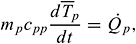 |
where  is the heat transfer rate to the particle. This quantity is given by (2.4.3). Therefore, a knowledge of T is sufficient to determine the particle temperature. However, the fluid temperature is determined by (2.1.7),

that is, by an equation that includes the pressure and velocity fields. Thus, the determination of the temperature of a rigid particle in a viscous, compressible fluid requires those fields. But, for slowly moving fluids, the squares of the velocity gradients may be neglected, a fact that amounts to neglecting viscous heating. Thus, ? f=0. Similarly, we may also neglect the convective terms on the left-hand side of (2.1.7). The next simplification involves the pressure field in the fluid. This is important for compressible fluids; but, for slow motions, the fluid may be taken as incompressible, in which case ? T ? 0. Hence, we find that the external fluid temperature is described by Fourier s heat...