Suspension Acoustics: An Introduction to the Physics of Suspensions

Written by a leading expert in the field, this book is an introduction to the physics of suspensions of bubbles, droplets, and solid particles in both gases and fluids.
 TABLE OF CONTENTS
 Because of its importance, it is useful to derive, again, Stokes law, (4.2.48) this time by considering a rigid sphere translating with a constant velocity u p . Relative to a frame of reference fixed on the sphere, the fluid motion is unsteady, so that the momentum equation for the fluid would have a time derivative of the velocity. Since the frame of reference is moving with constant velocity, the time derivative can be expressed as ?u p ? u f. Therefore, the Stokes equations are
| (4.3.1) |  |
| (4.3.2) |  |
This set still contains the nonlinear convective acceleration, which contains two terms. If we neglect both on the basis that the Reynolds number is small, we obtain, upon taking the curl of the resulting equation,
| (4.3.3) |  |
This can be expressed in terms of the stream function, in terms of which (4.3.2) becomes
| (4.3.4) | 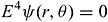 |
Thus, if we put, as before,
| (4.3.5) |  |
where f(r) satisfies
| (4.3.6) |  |
To solve this equation, we seek a solution of the form f(r)= r q , with q unknown. Substituting assumed solution into (4.3.6) shows that such as solution exists with q satisfying
| (4.3.7) |  |
The roots of this are q 1 = ?1 , q 2=1, q 3 =2 , and q 4 =4. Thus, in the steady case, the function f is
| (4.3.8) |  |
The boundary condition at infinity requires that C=D=0; those at r=a yield
| (4.3.9a,b) |  |
Hence,...